The Ultimate Guide to Construction Workwear Ireland: Safety, Durability & Compliance
Why Construction Workwear Matters in Ireland
Let's be honest: working on an Irish construction site without the right gear isn't just uncomfortable—it's dangerous. Between the rain that seems to fall sideways and the mud that clings to everything, your workwear is your first line of defense. But it's also about compliance, professionalism, and plain old survival on the job.
Construction workwear Ireland has evolved significantly over the past decade. It's no longer just about throwing on any old pair of jeans and a hi-vis vest. Modern standards demand specific materials, certifications, and fit. And if you're a site manager or business owner in North Dublin, getting this right can mean the difference between a smooth-running project and a safety incident that shuts everything down.
Legal Requirements and Safety Standards
The Health and Safety Authority (HSA) in Ireland doesn't mess around. Construction sites must comply with the Safety, Health and Welfare at Work (General Application) Regulations 2007. These regulations mandate that employers provide appropriate personal protective equipment (PPE) free of charge. And employees have a duty to wear it.
What does that mean in practice? Every worker needs high-visibility clothing that meets EN ISO 20471 standards. Safety footwear must comply with EN ISO 20345. Hard hats need EN 397 certification. These aren't suggestions—they're legal requirements. Fail an HSA inspection, and you're looking at fines that can reach €3,000 per offence. Or worse, a serious injury that could have been prevented.
The Irish Climate and Workwear Challenges
Ireland's weather is a beast of its own. We get an average of 225 rainy days per year in some parts of the country. That means your workwear needs to handle constant moisture, cold temperatures, and the occasional surprise hailstorm. But here's the kicker: waterproof gear that doesn't breathe will leave you soaked in sweat instead of rain. Finding that balance is critical.
From experience, most companies skip the breathability factor. They buy the cheapest waterproof jacket they can find, and within a month, workers are complaining about being clammy and uncomfortable. That's not just a comfort issue—it's a safety issue. Discomfort leads to distraction, and distraction leads to accidents.
Must-Have Construction Workwear Items for Irish Sites
So what exactly should be in your workwear wardrobe? Let's break it down by category.
High-Visibility Clothing: Classes and Standards
Not all hi-vis is created equal. There are three classes under EN ISO 20471, and each one is suited for different environments:
| Class | Minimum Visible Area | Best For |
|---|---|---|
| Class 1 | 0.14 m² | Low-risk areas like car parks or warehouses |
| Class 2 | 0.50 m² | Road construction, utility work, busy sites |
| Class 3 | 0.80 m² | High-speed roads, night work, emergency services |
For most construction sites in Ireland, Class 2 or Class 3 high visibility workwear is the standard. Don't skimp on this. A worker hit by a vehicle because their vest wasn't bright enough is a tragedy that proper gear could have prevented.
Safety Footwear: Steel Toe vs. Composite Toe
This is where a lot of debate happens. Steel toe boots have been the gold standard for decades. They're tough, they're proven, and they'll stop a falling brick cold. But they're heavy. And in cold weather, they conduct heat away from your feet, making you miserable.
Composite toe boots use materials like Kevlar, carbon fibre, or fibreglass. They're lighter, they don't conduct heat or cold, and they won't set off metal detectors—handy if you're working near sensitive equipment. The trade-off? They're generally more expensive and can be less impact-resistant than steel in extreme conditions.
Honestly, for most Irish construction work, composite toe boots are the better choice. You'll be on your feet for 8-10 hours a day. The weight savings add up. And with modern manufacturing, the safety difference is negligible for typical site hazards. Just make sure whatever you buy carries the EN ISO 20345 mark with a minimum S3 rating (waterproof and anti-static).
Head and Hand Protection Essentials
Hard hats are non-negotiable. Under EN 397, they must protect against falling objects and penetration. But here's something most people overlook: hard hats have an expiration date. UV exposure, temperature changes, and general wear degrade the plastic. Replace them every 3-5 years, or immediately after a significant impact.
Gloves are trickier. There's no one-size-fits-all solution. You need different gloves for different tasks:
- Cut-resistant (EN 388) for handling metal, glass, or sharp materials
- Impact-resistant (EN 13594) for demolition or heavy hammering
- Chemical-resistant (EN 374) for working with concrete, adhesives, or solvents
- Thermal gloves for Ireland's cold, wet winters
Eye protection is another area where people cut corners. A single speck of concrete dust in your eye can cause corneal abrasion. Always wear safety glasses or goggles that meet EN 166 standards. And keep them clean—scratched lenses reduce visibility and defeat the purpose.
Choosing the Right Materials for Durability and Comfort
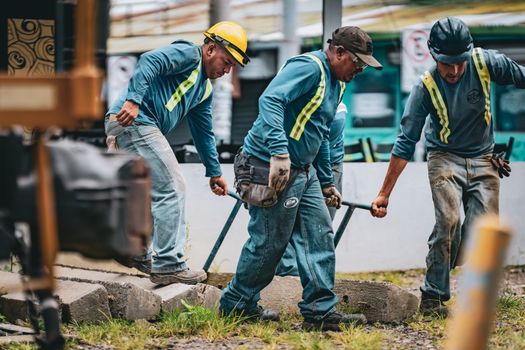
The fabric your workwear is made from determines how long it lasts and how comfortable you are wearing it. This is especially important for work pants for men and women on Irish sites, where you're constantly bending, kneeling, and moving.
Cotton vs. Polyester vs. Blends
Pure cotton is comfortable and breathable, but it absorbs water like a sponge. In Ireland's rain, that means you're carrying around an extra kilogram of water weight by lunchtime. It also dries slowly and offers poor abrasion resistance.
Polyester is durable, quick-drying, and holds colour well. But it doesn't breathe as naturally as cotton, which can lead to overheating in summer or clamminess in winter.
The sweet spot is a cotton-polyester blend, typically 65% polyester and 35% cotton. You get the durability and quick-drying properties of polyester with the breathability and comfort of cotton. Many modern workwear brands also add a touch of elastane (2-5%) for stretch, which makes a huge difference when you're climbing scaffolding or crouching to lay pipe.
Waterproof and Breathable Technologies
This is where the real magic happens. Gore-Tex is the gold standard, but it comes with a price tag. The membrane has billions of microscopic pores that are 20,000 times smaller than a water droplet but 700 times larger than a water vapour molecule. Translation: rain stays out, sweat escapes.
There are cheaper alternatives like eVent, Sympatex, and proprietary membranes from brands like Portwest and Helly Hansen. They work well for most construction applications. The key spec to look for is the waterproof rating (mm) and breathability rating (g/m²/24h). For Irish construction, aim for at least 10,000mm waterproof and 10,000g breathability.
And don't forget about reinforced stitching and ripstop fabrics. Ripstop nylon has a reinforcing grid woven into the fabric that stops tears from spreading. Combined with double- or triple-stitched seams, this can double the lifespan of your workwear. That's a big deal when you're buying for a crew of 20.
Customisation and Branding: Adding Logos to Workwear
Here's something that separates professional crews from the rest: branded workwear. When every worker on your site wears matching gear with your company logo, it does more than look good. It improves site security (you can spot an unauthorised person immediately), builds team pride, and markets your business every time a worker stops for lunch or fuel.
Embroidery vs. Screen Printing vs. Heat Transfer
Each method has its strengths:
- Embroidery — Uses thread to stitch the logo directly into the fabric. It's durable, professional-looking, and stands up to industrial washing. Best for polo shirts, jackets, and caps. Slightly more expensive per piece, but lasts the life of the garment.
- Screen printing — Applies ink through a mesh stencil. Great for large orders on t-shirts or hi-vis vests. The print can crack or fade over time, especially with frequent washing.
- Heat transfer (vinyl) — A design is cut from coloured vinyl and heat-pressed onto the fabric. Works well for small runs or complex designs, but can peel off after repeated washing.
For construction workwear, embroidery is the clear winner. It's tough, looks premium, and doesn't compromise the integrity of high-visibility materials. Logowear.ie specialises in high-quality embroidery for construction uniforms in North Dublin. They use commercial-grade machines that handle bulk orders efficiently, and their work holds up even after dozens of industrial wash cycles.
Why Custom Workwear Boosts Team Identity
Think about it: when your crew walks onto a site wearing matching gear with your logo, they look like professionals. It signals to clients and site managers that you run a tight ship. It also helps with accountability—workers are less likely to cut corners when they're visibly representing the company.
From a security standpoint, branded safety workwear North Dublin sites makes it dead simple to identify who belongs and who doesn't. That's a real advantage on busy multi-contractor sites where dozens of different crews might be working simultaneously.
Where to Buy Construction Workwear in Ireland
You've got options. Let's walk through them.
Online vs. Local Suppliers
Online retailers like Screwfix and Amazon offer convenience and competitive pricing. But there are downsides. You can't try things on. Shipping times can be unpredictable. And if something doesn't fit or fails prematurely, returns are a hassle.
Local suppliers—especially specialists like Logowear.ie—offer something online giants can't: personalised service. They'll help you select the right products for your specific needs, ensure proper sizing, and handle custom embroidery in-house. For bulk orders, they often match or beat online prices, and delivery is faster because they're based in North Dublin.
Top Irish Retailers and Specialists
Here's a quick rundown of where to find construction workwear Ireland:
| Supplier | Best For | Notes |
|---|---|---|
| Logowear.ie | Custom embroidery, bulk orders, branded uniforms | Local North Dublin supplier with fast turnaround |
| Screwfix | Basic PPE, footwear, standard hi-vis | Good for quick purchases, limited customisation |
| Work 'n' Wear | Branded workwear, safety boots, accessories | Nationwide stores, decent range |
| Portwest | Manufacturer-direct, wide range of PPE | Irish brand, excellent quality, no customisation |
Logowear.ie stands out because they combine product selection with customisation. Need 50 hi-vis jackets with your company logo embroidered on the chest and back? They can do it. Need them in a week? Usually, yes. That kind of flexibility is hard to find with larger retailers.
Sizing, Fit, and Maintenance Tips
You can buy the most expensive workwear in the world, but if it doesn't fit properly, it's useless. Here's what to watch for.
Getting the Right Fit for Safety and Mobility
Workwear that's too loose can snag on equipment or scaffolding. Workwear that's too tight restricts movement and can cause chafing or fatigue. The sweet spot is a fit that allows full range of motion without excess fabric.
For work pants for men, look for features like articulated knees (pre-shaped for bending), gusseted crotches (reduces stress on seams), and adjustable waistbands. For jackets, ensure you can lift your arms above your head without the hem riding up. And always try on safety boots with the socks you'll actually wear on site—thick thermal socks change the fit completely.
How to Extend the Life of Your Workwear
Irish construction workwear takes a beating. But with proper care, you can double its lifespan:
- Wash hi-vis separately from other clothes to avoid colour transfer that reduces visibility.
- Use liquid detergent, not powder. Powder can clog the pores in waterproof membranes.
- Never use fabric softener on hi-vis or waterproof gear. It breaks down the reflective properties and clogs breathable membranes.
- Air dry whenever possible. High heat damages elastic, reflective tape, and waterproof coatings.
- Store workwear in a dry, ventilated area. Damp storage promotes mould and degrades fabrics.
When should you replace gear? The rule of thumb is: if the reflective tape has started peeling, if the waterproof membrane is leaking, or if there are tears in the fabric that compromise structural integrity, it's time for a replacement. Don't wait for an HSA inspector to point it out.
Common Mistakes When Buying Construction Workwear
I've seen the same mistakes repeated over and over. Let's save you the trouble.
Prioritising Price Over Safety
Look, I get it. Budgets are tight. But cheap safety boots Ireland that cost €30 will need replacing in three months. A quality pair at €90 will last a year or more. That's not just a cost saving—it's a safety improvement. Cheap boots have thinner soles, less ankle support, and inferior slip resistance. On a wet Irish site, that's a recipe for a fall.
Ignoring Climate-Specific Needs
Workwear designed for a dry climate won't work in Ireland. I've seen crews buy standard cotton coveralls that soak up rain like a sponge. Within an hour, they're cold, wet, and miserable. Productivity tanks. Accidents happen. Spend the extra on waterproof, breathable gear. Your workers will thank you, and your project will stay on schedule.
Failing to Check Certification Labels
This is the biggest one. Every piece of safety workwear sold in Ireland must carry the appropriate CE marking and EN standard. If it doesn't have the label, it's not certified. Don't trust "CE compliant" claims on product descriptions—check the actual label on the garment. Counterfeit PPE is a real problem, especially with online marketplaces. Buy from reputable suppliers like Logowear.ie who source directly from certified manufacturers.
Final Advice: Building Your Workwear Wardrobe
If you're starting from scratch or equipping a new crew, here's my recommended starter kit for Irish construction sites:
- Class 3 hi-vis jacket with waterproof membrane and detachable hood
- Class 2 hi-vis vest for warmer days (layering is key in Irish weather)
- S3 composite toe safety boots with waterproof lining and anti-static sole
- Two pairs of work pants with reinforced knees and multiple pockets
- Hard hat with adjustable suspension and chin strap
- Cut-resistant gloves (EN 388 level 4 or higher)
- Safety glasses with anti-fog coating
- Waterproof trousers for heavy rain days
That's your foundation. From there, you can add branded polo shirts for warmer months, thermal base layers for winter, and custom embroidery to tie it all together.
Logowear.ie can handle bulk orders and custom embroidery for teams of any size. They're based in North Dublin, which means fast delivery and personal service Construction workwear in Ireland must comply with EU and Irish safety standards, including CE marking for personal protective equipment (PPE). Key standards include EN 388 for cut resistance, EN 20471 for high-visibility clothing, and EN ISO 20345 for safety footwear. Compliance ensures protection against hazards like impact, cuts, and slips on construction sites. For Ireland's wet and windy climate, durable workwear includes waterproof and breathable jackets, reinforced trousers with knee pad pockets, and high-visibility vests with anti-static properties. Materials like ripstop cotton, polyester blends, and Cordura fabric offer longevity, while thermal layers are recommended for colder months. To meet Irish regulations, choose workwear that is CE-certified and compliant with the Personal Protective Equipment (PPE) Regulations 2018 (S.I. No. 113/2018). Regularly inspect gear for damage, replace worn-out items, and ensure proper fitting. Consult suppliers who specialize in Irish construction standards for guidance. Popular brands in Ireland include Portwest, Carhartt, and Snickers Workwear, known for their durability and compliance with safety standards. Local suppliers like Regatta Professional and Dickies also offer options tailored to Irish conditions. Always verify product certifications before purchase. Yes, task-specific workwear is recommended. For example, high-visibility vests are crucial for roadworks, while flame-resistant clothing is needed for welding. Waterproof gear is essential for outdoor tasks in rain, and steel-toe boots are mandatory for heavy lifting. Assess risks per job to select appropriate PPE.Najczesciej zadawane pytania
What are the essential safety standards for construction workwear in Ireland?
What types of construction workwear are most durable for Irish weather conditions?
How can I ensure my construction workwear meets Irish health and safety regulations?
What are the best brands for construction workwear in Ireland?
Do I need different workwear for different construction tasks in Ireland?